
Designing a Language with a VM Model but without Runtime Bloat
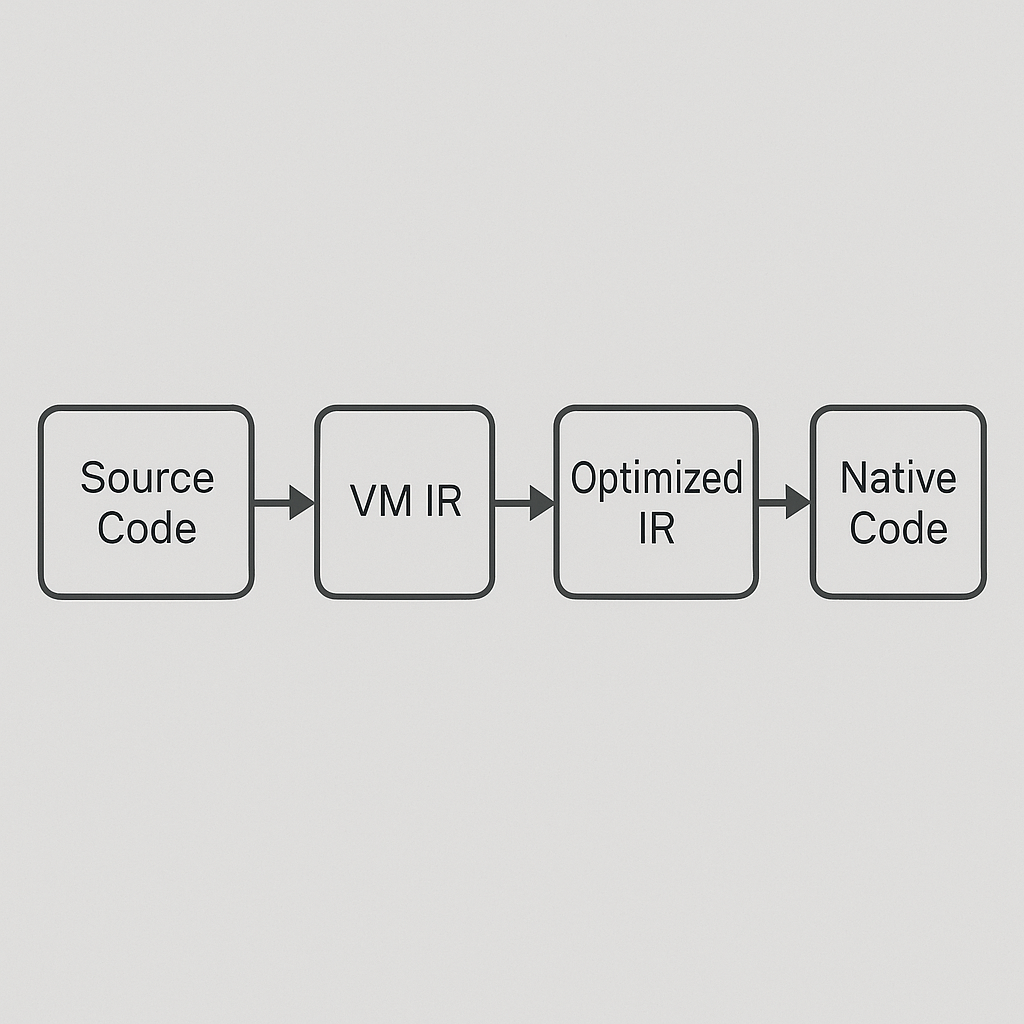
Many developers want the clarity and control that comes from designing a language around a custom virtual machine, but they do not want to ship a heavy runtime, a slow interpreter, or a dependency that resembles Java or the .NET framework. A language can use a virtual machine internally while still producing very small native binaries. The VM becomes the semantic core, not a component that must be delivered to the end user. This article explains how such a system can be designed, how to structure the toolchain, and how to keep native executables small and portable.
Table of Contents
- Background: Transpiling to High Level Languages
- Using a VM as an Internal Model
- Ensuring No VM Is Needed at Runtime
- Methods for Producing Small Native Binaries
- Controlling Runtime Size
- Size of the VM in This Model
- Why Use a VM Internally
- Real World Uses
- Example Workflow
- Conclusion
Background: Transpiling to High Level Languages
A common early strategy in language design is to transpile to an existing language such as C, C++, Rust, JavaScript, or Python.
Advantages:
- reuse of established compilers
- platform portability
- free tooling
- reduced initial engineering effort
However, this introduces problems.
Issues with semantics:
- evaluation order differences
- incompatible integer rules
- mismatched memory models
- incompatible error handling
- garbage collection assumptions
- pointer and aliasing rules you do not control
Issues with performance:
- hidden allocations
- reordering of operations
- unexpected bounds checks
- unpredictable optimizations
- timing differences across host versions
Using a VM as an Internal Model
A more stable approach is to define an internal virtual machine that encodes the semantics of your language. This VM is not shipped with user applications.
Benefits:
- precise semantics
- stable representation for all backends
- straightforward debugging
- clean path to interpreters, JIT engines, or AOT compilers
- well understood design patterns
VM forms:
- stack based bytecode
- register based bytecode
- SSA based IR
- custom instruction sets
Ensuring No VM Is Needed at Runtime
A language can use a VM internally while delivering pure native binaries.
Compiler only mode:
- Parse and typecheck.
- Lower to VM IR.
- Optimize IR.
- Translate to C, LLVM IR, or direct machine code.
- Emit a static native binary.
Development VM mode:
- REPL
- scripting
- debugging
- prototyping
Hybrid mode:
- interpreted VM optional
- compiled binaries never depend on it
Methods for Producing Small Native Binaries
Several established paths produce small binaries while using a VM internally.
Approach A: lower IR to C
- high portability
- very small binaries with a minimal C runtime
- proven C optimizers
- predictable size
Approach B: lower IR to LLVM IR
- strong optimization pipeline
- multi architecture output
- ahead of time compilation
- link time optimization for compact results
Approach C: direct machine code generation
- full control of emitted code
- smallest possible footprint
- precise low level optimization
Controlling Runtime Size
A minimal runtime avoids the large footprints found in traditional VM ecosystems.
Keep the runtime minimal:
- string utilities
- optional bounds checking
- allocation helpers if needed
- minimal IO wrappers
Avoid:
- reflection systems
- heavy metadata
- JIT engines
- large class libraries
- complex GC systems unless required
Make advanced features opt in. Split the standard library into modules. Provide freestanding and minimal modes.
Size of the VM in This Model
The VM lives in the compiler, not the output binary.
Typical runtime sizes:
- minimal: 50 to 200 KB
- with utilities: 200 to 400 KB
- with small GC: 400 KB to 1.5 MB
Why Use a VM Internally
Reasons:
- precise semantics
- predictable behavior across targets
- simpler backend development
- clearer debugging
- future optional JIT support
Real World Uses
This model supports:
- command line tools
- servers
- native applications
- games
- embedded systems
- desktop software
- scripting and extension systems
Example Workflow
- Write code
- Parse and typecheck
- Lower to VM IR
- Optimize IR
- For development:
- interpret IR
- debug IR
- For production:
- lower to C or LLVM IR
- compile to native code
- produce a static binary
Conclusion
Using a VM internally gives clear semantics, stable architecture, and small executables without shipping a virtual machine. It avoids semantic mismatches, produces predictable performance, and provides a strong base for future features.